I Spent 4 Hours Micro-Scheduling a Stressed College Student’s Week. Here’s What I Learned. | Self-awareness | Self-improvement | Productivity | Mindfulness | Mental Health | Micro-Scheduling
I Spent 4 Hours Micro-Scheduling a Stressed College Student’s Week. Here’s What I Learned.
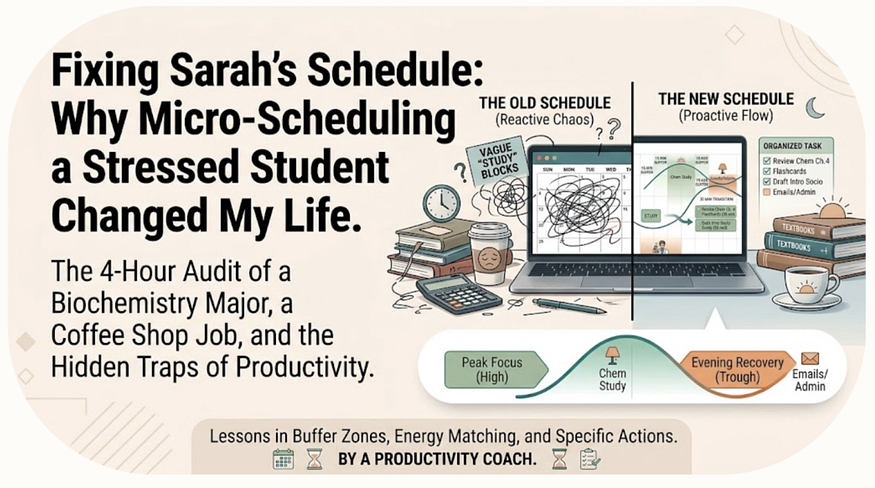
Last week, I sat down with Sarah.
Sarah is a junior majoring in Biochemistry, balancing a part-time job at a campus coffee shop, a heavy course load, and the desperate desire to maintain a social life. When she hopped on our Zoom call, she looked visibly exhausted. She opened her laptop and showed me her schedule: a chaotic, color-coded grid that looked like a game of Tetris gone horribly wrong.
“I spend half my Sunday planning,” Sarah told me, running a hand through her hair. “But by Wednesday, I’m completely overwhelmed, behind on assignments, and operating on four hours of sleep. I don’t get it. I’m trying so hard.”
Sarah was trapped in a cycle that millions of students and professionals find themselves in. She didn’t have a time-management problem. She had a design problem.
I told her to close her calendar app. For the next four hours, we tore her week apart and rebuilt it from scratch, block by block.
What I discovered during those four hours explained exactly why most productivity advice fails miserably in the real world. Here is what happens when you actually audit a human life — and the hidden mistakes that are draining your daily energy.
Mistake 1: The “Ghost Time” Illusion (Forgetting the In-Between)
When Sarah showed me her initial schedule, it looked incredibly productive. She had a lecture ending at 11:45 AM, and her next study block scheduled for 12:00 PM.
On paper, that’s a clean 15-minute gap. In reality, it was a trap.
In the real world, that 15-minute window looks like this: packing up her laptop, walking across a crowded campus, bumping into a classmate, waiting in a long line for a quick snack, and finding an empty desk in the library. By the time she actually opened her notebook, it was 12:15 PM.
Because she was already “late” according to her calendar, a wave of micro-stress hit her. She felt like she was constantly running behind, losing momentum before she even started.
The Fix:
We added mandatory “Buffer Blocks.” We mapped out her actual commute times, walking distances, and transition periods. By acknowledging that human beings cannot instantly teleport from one task to another, we eliminated the phantom guilt of running late.
Mistake 2: Ignoring the “Brain Fog” Factor
Sarah’s hardest task of the week was writing her lab reports — a heavy, deeply analytical process. Where did she schedule it? Tuesdays and Thursdays from 7:00 PM to 9:00 PM.
Do you know what Sarah does right before 7:00 PM? She finishes a four-hour shift at the coffee shop, standing on her feet and dealing with demanding customers.
Expecting her brain to seamlessly transition from customer service exhaustion into high-level scientific analysis was biologically unrealistic. Your brain does not operate at 100% capacity for 16 hours a day. Energy is a finite resource that fluctuates based on your circadian rhythm and daily tasks.

The Fix:
We rearranged her tasks based on Energy Matching, not just time availability. We moved her lab reports to Friday mornings — a block where she had no classes and a fresh mind — and shifted her evenings to low-energy tasks like sorting emails, organizing digital files, and doing laundry.
Mistake 3: The “Catch-All” To-Do List
Sarah had a block on Wednesday afternoons simply labeled: “Study.”

The Fix:
We transformed her calendar from a list of times into a list of actions. “Study” became “Review Chemistry Chapter 4 flashcards (30 mins)” followed by “Draft intro for Sociology essay (45 mins).” By removing the need to make decisions on the spot, she could just sit down and immediately execute.
The “Before” vs. “After” Transformation
By the end of our four hours, Sarah’s schedule looked vastly different. It actually looked less crowded, even though she was getting more done.

The result? Sarah texted me three days later: “For the first time in months, I actually relaxed on a Thursday night without feeling like I was neglecting an assignment. Knowing exactly when everything was going to get done completely turned off the background anxiety in my brain. Thank you, Arden!”
Why You Shouldn’t Do This Alone
Mapping out a schedule like this works wonders, but it is incredibly exhausting to do for yourself. It requires you to step outside your own life, look at your habits objectively, calculate your energy levels, and organize the puzzle pieces without letting bias get in the way.
It took me four hours of intense data auditing to fix Sarah’s week. Most people don’t have a spare four hours just lying around to map out their time management.
Which is exactly why I want to do it for you.
You don’t need to spend hours staring at a blank calendar trying to fix your routine. For just $3 — less than what Sarah charges for a single latte at her coffee shop — I will manually build your custom daily routine blueprint.
Here is the deal:
- Secure Your Slot: Click the link below to grab a spot for $3.
- Fill Out the Audit: You’ll get a link to a detailed Google Form asking about your current routine, your highest-priority goals, your energy slumps, and your non-negotiable commitments.
- Get Your Plan: I will personally analyze your answers and manually construct a realistic, context-aware timetable tailored specifically to your life.
- Fast Delivery: It will land directly in your email inbox within 24 hours, ready for you to use.
Stop fighting against your own clock and wasting energy trying to figure out what to do next. Let me handle the architecture so you can focus on the execution.
[Click here to claim your $3 slot and get your custom timetable within the next 24 hours.]


Comments
Post a Comment